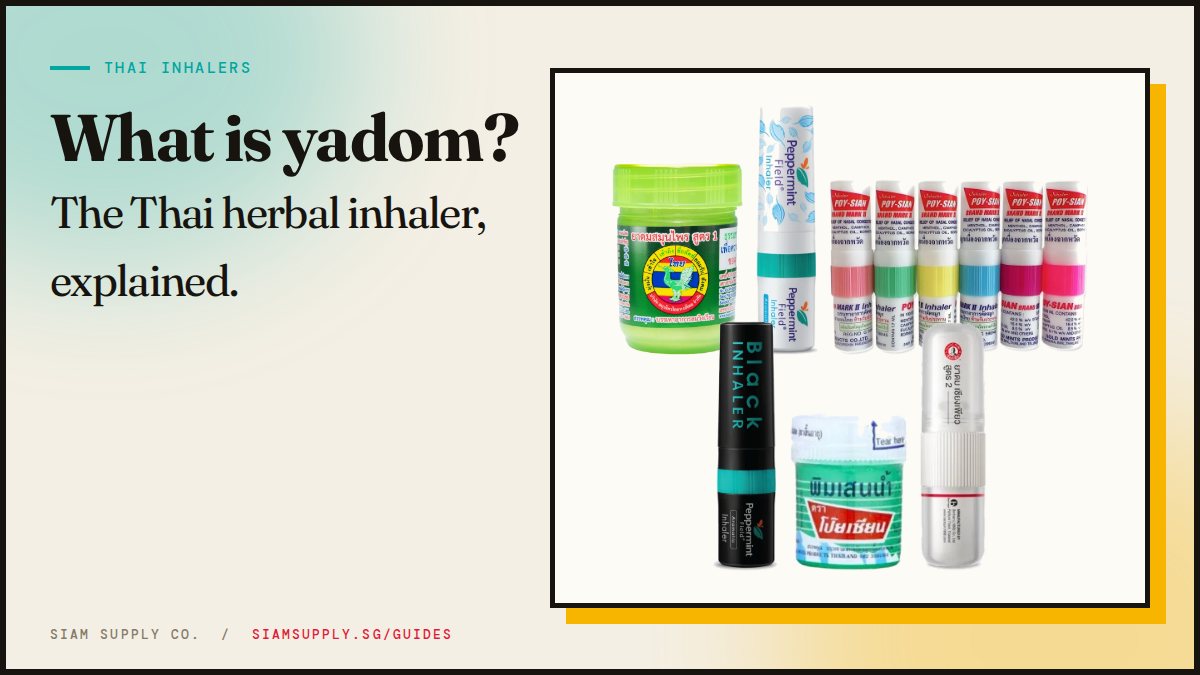
Yadom (ยาดม) is a Thai herbal inhaler. The name means "smelling medicine": ya is medicine and dom is to smell. It is a small stick, jar or bottle holding menthol, camphor, borneol and plant oils, and you breathe it in for a blocked nose, dizziness, travel sickness or simply to feel more alert.
If you have been to Thailand you have seen them everywhere: in taxi dashboards, on office desks, hanging on the rack beside the till at every 7-Eleven. In Singapore they have moved from the "bring me back some" list to provision shops, pharmacies and bazaar stalls, and "thai inhaler" is now searched around 2,400 times a month here. This guide explains what is actually in one, the four formats you will meet, how to use one properly, and who should not.
What yadom means, and where it comes from
Smelling remedies have a long history in Thai traditional medicine. The Thailand Foundation traces the modern fashion for fragrance to the reign of King Rama II (1809 to 1824), and some of today's brands are old in their own right: Poy-Sian has been making inhalers since 1936.
Thailand also treats yadom as an ordinary medicine rather than a novelty. It is listed as a household remedy under a 2007 order of the Thai Ministry of Public Health, which is why it sits on the open shelf in Thai pharmacies rather than behind the counter.
Part of its recent spread outside Thailand is simple visibility. Blackpink's Lisa was photographed with a Hong Thai inhaler in 2023, and in 2024 the Thai Ministry of Commerce named the Hong Thai brand as a "soft power" export. Both did more for Thai inhalers abroad than any advertising.
What is inside a Thai inhaler
The formulas differ by brand, but almost every yadom is built from the same short list of ingredients:
- Menthol, which gives the cold rush you feel in the nose. It is usually the largest single ingredient.
- Camphor, the sharp medicinal note. Traditionally used for congestion and coughs.
- Borneol, a cooling crystal used in Thai remedies for dizziness.
- Plant oils such as eucalyptus, peppermint and clove, which give each brand its character.
For a sense of proportions, the label on a Poy-Sian Mark II lists menthol at 42.0%, camphor at 16.4%, eucalyptus oil at 8.5% and borneol at 6.1%. A Hong Thai jar is built on the same four ingredients, with the herbs left loose in the jar rather than soaked into a wick.
The four formats you will see
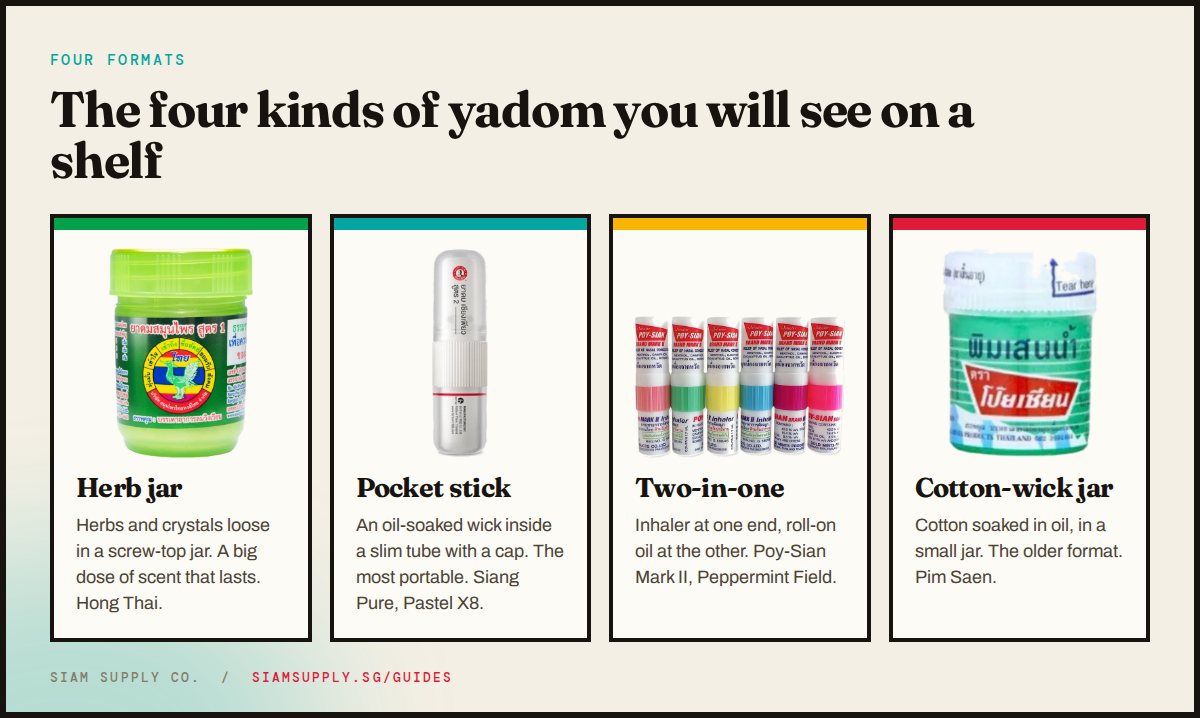
"Thai inhaler" covers several quite different objects. Knowing which is which saves buying the wrong one.
The herb jar
A screw-top jar of loose herbs and crystals. You unscrew the lid and breathe from the open jar. Because there is so much material in it, a jar keeps its scent far longer than a stick. Hong Thai is the one everybody recognises, by its green jar and the bird on the label.
The pocket stick
A wick soaked in oil, sealed in a slim tube with a cap. This is the classic "Vicks-style" shape, made smaller and neater. It fits in a shirt pocket and is the least conspicuous to use in public. Pastel X8 and the Siang Pure inhaler are both this format.
The two-in-one
An inhaler at one end and a small roll-on oil at the other. You breathe from the top, and unscrew the bottom to roll oil onto the temples or under the nose. Poy-Sian Mark II made this format famous, and Peppermint Field does a cleaner, more modern version of it.
The cotton-wick jar
Cotton soaked in liquid oil inside a small jar, sold with a tear seal. It is the oldest format of the four and still the one older users reach for. Pim Saen is the best-known example.
How to use a Thai inhaler properly
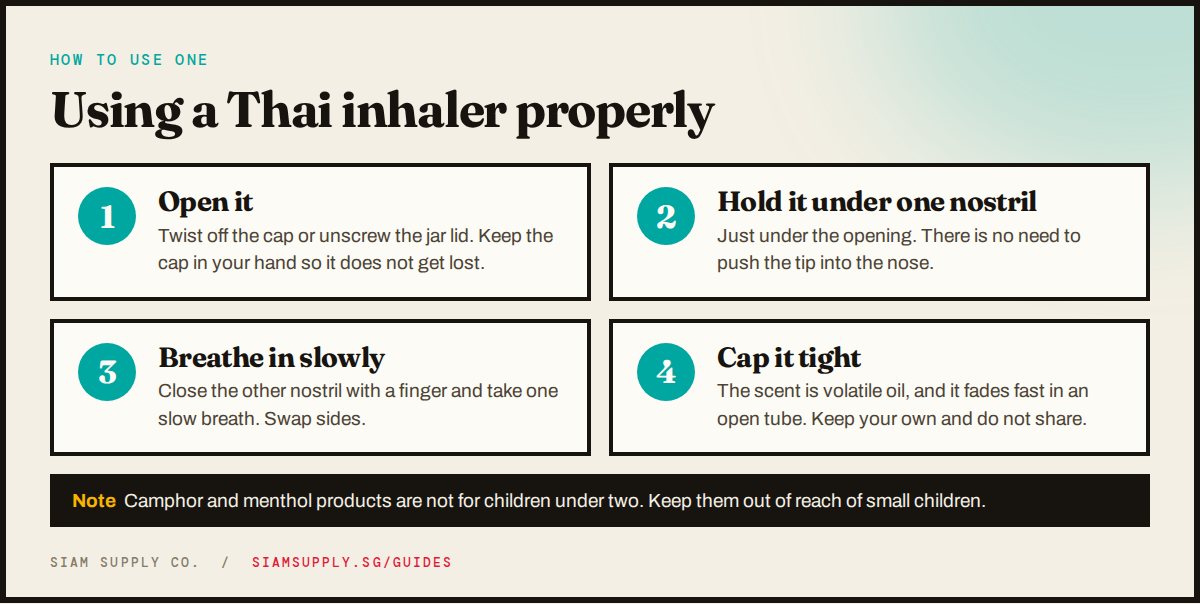
- Open it. Twist off the cap or unscrew the jar lid.
- Hold it just under one nostril. There is no need to push the tip into your nose. The vapour does the work.
- Breathe in slowly while closing the other nostril with a finger. One slow breath per side is enough to start with.
- Cap it tight straight away. The scent comes from volatile oils, and an open inhaler fades quickly.
Two habits make an inhaler last and keep it clean. Keep your own, because the tip touches your nose and sharing it is sharing whatever is on it. And keep it out of the sun and away from a hot car, which drives the oils off faster.
Who should not use one
Thai inhalers are mild products, but camphor and menthol are real active ingredients, not perfume.
- Children under two. Camphor-menthol products carry a "do not use" warning for this age group, because small children are more sensitive to camphor. For a baby with a blocked nose, an onion-based sticker such as Happy Noz is the usual Thai alternative, since it goes on clothing rather than near the face.
- Anyone with asthma or a history of reactions to strong scents should check with a doctor or pharmacist first.
- Pregnant women are commonly advised to ask a pharmacist before using camphor products.
Keep all of them out of reach of small children. Camphor is harmful if swallowed, and a pocket inhaler looks a lot like a sweet.
Is it the same as a nasal spray?
No. A pharmacy decongestant spray delivers a drug directly onto the lining of the nose and should only be used for a few days. A yadom simply gives off a scent you breathe in. It feels like it clears the nose because menthol triggers the cold receptors inside it, which is why many people use one alongside, not instead of, whatever their doctor recommends.
A note on the 2025 Hong Thai recall
In October 2025 one production lot of Hong Thai Formula 2, lot 000332, was recalled after Thailand's FDA found microbial contamination. It was a single lot, and Singapore's HSA advised anyone holding it to stop using it. Our Hong Thai recall explainer has the batch details and how to check a jar.
Where to find them in Singapore
Thai inhalers are sold in provision shops, Thai supermarkets, TCM halls, some pharmacies, and online. If you run a shop and want to carry them, we import all of the brands above direct from Hat Yai; the Thai inhaler wholesale range compares them for a shop counter. In our own orders, Poy-Sian is the usual first line for a shop trying Thai inhalers for the first time, because it is the cheapest unit and people already know it.
Questions people ask
What does yadom mean?
Yadom (ยาดม) means "smelling medicine" in Thai. "Ya" is medicine and "dom" is to smell.
What is in a Thai inhaler?
Mostly menthol, camphor and borneol, with plant oils such as eucalyptus, peppermint or clove. A Poy-Sian Mark II, for example, lists menthol 42.0%, camphor 16.4%, eucalyptus oil 8.5% and borneol 6.1%.
How long does a Thai inhaler last?
It depends on the format and how tightly you cap it. A herb jar lasts longest because it holds the most material; a pocket stick fades faster, especially if left open or in a hot car.
Can children use Thai inhalers?
Not children under two, because camphor and menthol products carry a warning for that age group. For older children, use sparingly and keep the inhaler out of reach.
Is yadom the same as Vicks?
They are similar in idea. Both are menthol-based inhalers you breathe from. Thai yadom usually adds camphor, borneol and herbal oils, and comes in more formats, including jars and two-in-one sticks.